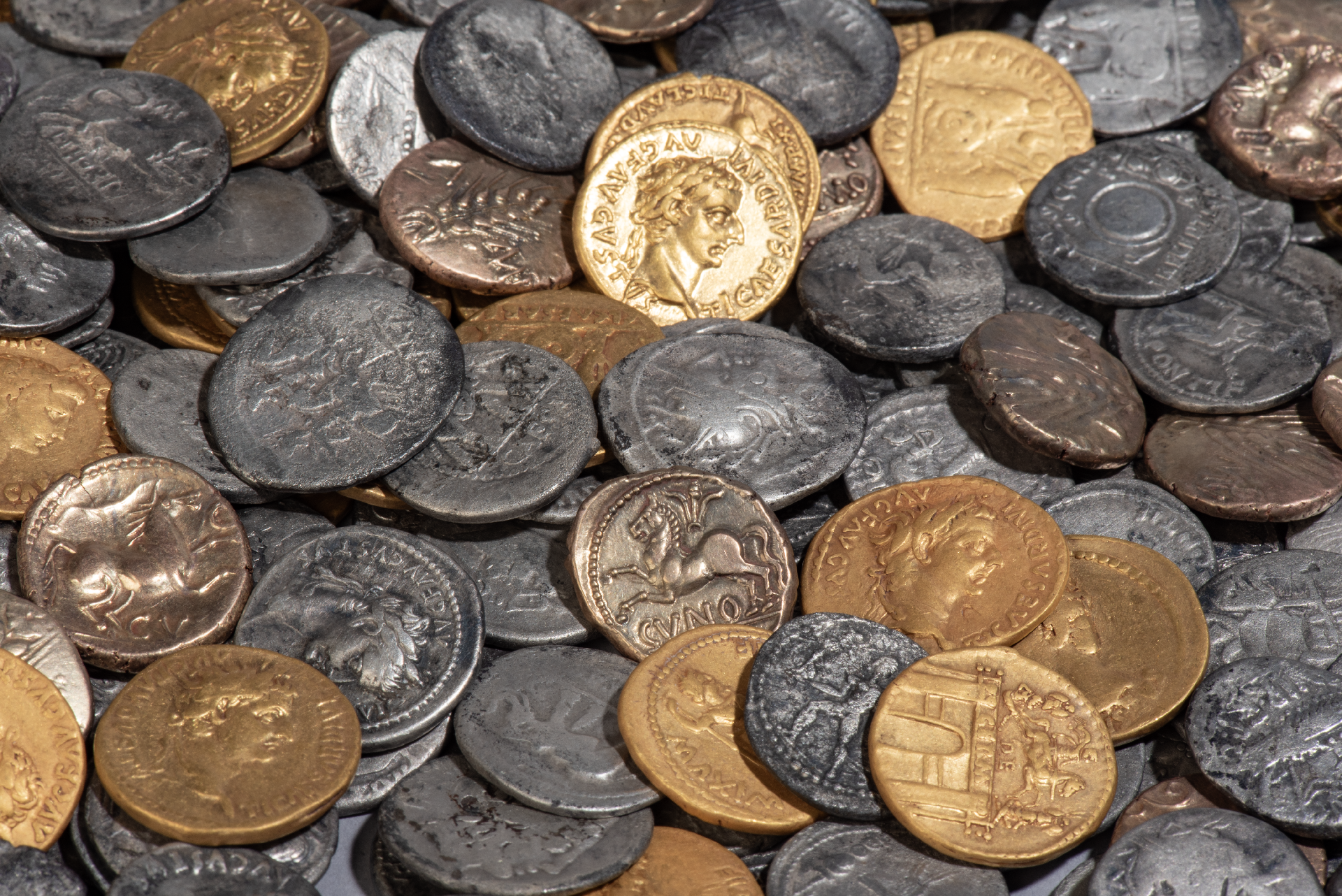
Een close-up van alle munten uit de Bunnikvondst van 2023. Rijksmuseum van Oudheden - 2024 CC0 1.0
A unique archeological find from Roman times in Bunnik
In the autumn of 2023, 404 silver and gold coins dating back to the start of the Common Era were found in the Dutch municipality of Bunnik, not far from Utrecht. The find contains a unique combination of Roman and British coins, buried in the northern border region of the Roman Empire (the Lower German Limes). Never before has such a Roman-British hoard been found on the European mainland!
In 43 CE, emperor Claudius gave the order for the Roman conquest of Britannia. The execution of this mission was entrusted to the Roman general Aulus Plautius. Preparations for the invasion had already taken place along the European coast and the Rhine in the years prior. With four legions and 20,000 auxiliary soldiers, Plautius crossed the North Sea. The huge invasion force, including Batavian soldiers, landed on the British coasts to move inland. With great force, the Romans charged various British tribes, including the Catuvellauni. Although the campaigns were successful from a Roman perspective, the conquest was a period of violence and oppression for the native British population.
Een close-up van alle munten uit de Bunnikvondst van 2023. Rijksmuseum van Oudheden - 2024 CC0 1.0
The Coin Hoard
The hoard consists of a total of 404 coins. The coins can be divided into three parts: 288 silver denarii, 72 gold aurei, both Roman and 44 gold British staters. The coins date between 200 BCE and 47 CE and represented a value of almost eleven annual salaries of a Roman soldier around the time of concealment. The youngest coins of the hoard are various denarii and two gold aurei of emperor Claudius made with the same coin stamp. These coins were struck in 46-47 CE, right around the end of the first phase of the Roman conquest of Britannia.
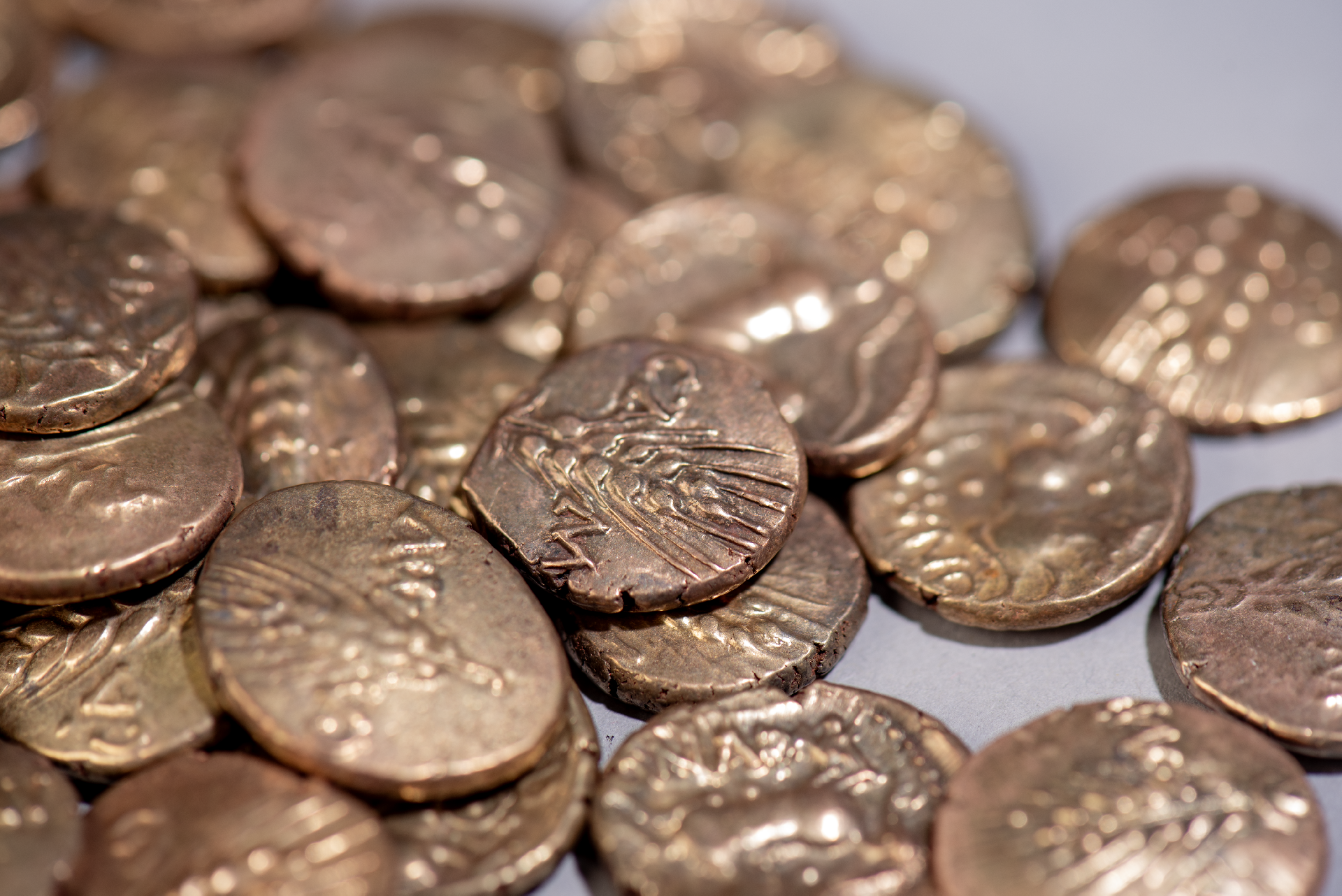
Other notable coins include a silver denarius of King Juba I of Numidia (60-46 BCE), present-day Algeria. And a gold aureus of Antonia Minor (36 BCE-37 CE) and several denarii of Julius Caesar (49-44 BCE). The gold staters, recognisable by a horse with the Latin inscription ‘CVNO’[BELINVS] on one side and an ear of wheat on the other, are minted in the name of the British King Cunobelinus. He ruled for an exceptionally long period over the British Celtic Catuvellauni tribe, from around 5 to 40 CE. Their territory has been ascribed to south-eastern England, around present-day Colchester (Essex).
Most of the coins were minted during Cunobelinus’ reign, except four specimens. These were struck after his death, around 43 CE, by presumably one or both of his sons and successors, Togodumnus and/or Caratacus. The coins are not of pure gold but are made from an alloy of gold, silver and copper. This gives them their unique colour.
Een close-up van alle munten uit de Bunnikvondst van 2023. Rijksmuseum van Oudheden - 2024 CC0 1.0
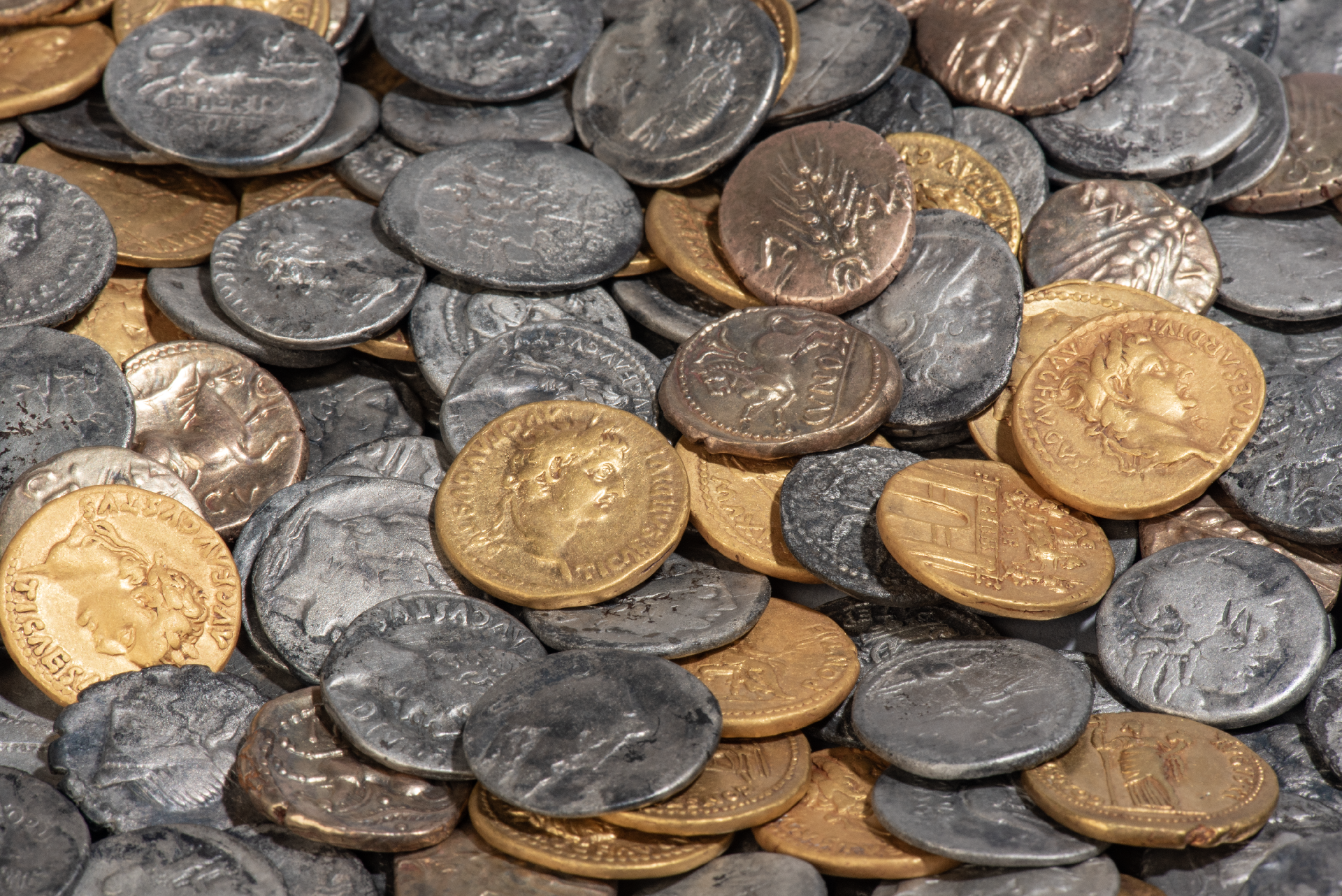
The British staters from the hoard were probably spoils of war, brought in by the Roman army from Britannia. The staters were thereafter combined with the aurei and denarii, presumably linked to military wages, and buried around 47 CE in a bag in a soggy area far from habitation. Perhaps the coins belonged to an officer who wanted to secure his savings, but for some reason never returned. Another possibility is that the hoard is a ritual deposition made by soldiers as a token of gratitude for their safe return from Britannia. Anyhow, the Bunnik coin hoard highlights the role of the Lower Germanic Limes, as a starting point for the conquest of Britannia in 43 CE and a return route, by which British coins and other objects reached continental Europe.
Keltisch-Britse staters uit ca. 5-40 na Chr, onder naam van koning Cunobelinus. Rijkmuseum van Oudheden - 2024 CC0 1.0
The Lower German Limes in Utrecht
In Roman times the Lower German Limes, the northern border of the Roman Empire, ran right through what is now the present-day Netherlands and the province of Utrecht. This border was established in the second half of the first century CE, following a period of turmoil, rebellions and military campaigns. The Limes enters the present-day Netherlands in the municipality of Zevenaar and follows the river Rhine via the Betuwe region and Utrecht to Katwijk on the North Sea coast. Along the Limes, the Romans built forts, roads, watchtowers, harbours, villas, temples and settlements. Thus creating a dynamic border region or frontier to protect the empire against invasions, for instance, by Germanic peoples living north of the Rhine. However, we should not see the Limes as an impenetrable border; there was much contact, trade and exchange between peoples north and south of the river.
In the area of what is now the province of Utrecht, the Limes followed the Rhine from Wijk bij Duurstede via the Kromme Rijn to Bunnik, after which it continued through Utrecht City to Woerden. In these places, many unique objects have been discovered, such as ships, votive stones, weapons, shoes, pottery and jewellery. Furthermore, in other Utrecht towns, such as Houten, IJsselstein and Rhenen, intricate discoveries have been made which provide valuable insights into the province's Roman past. In 2021 the Lower German Limes in Netherlands and Germany was declared a Unesco World Heritage Site.
Extra info
| Thema | The Roman Coin Hoard of Bunnik Romeinen en de Limes |
|---|---|
| Type | Geschreven verhaal |
| Periode | Oudheid (300 v. Chr tot 500 n. Chr.) |
| Organisatie | Landschap Erfgoed Utrecht |
| Regio | Kromme Rijn |
| Plaats | Bunnik, Nederland |
| Permalink |